
Most leaning fences are a post problem. Water collects around a shallow post, freezes and lifts it, and a concrete collar that flares out at the surface gives the frost something to push on. This fall, check for rot at ground level, posts that move and gates that drag. Fix loose boards and hardware before the snow, and leave post replacement for spring, when the ground can be dug.
How frost pushes a fence out of line
Soil holds water, and water expands when it freezes. In a GTA winter the top layer of the yard freezes and thaws over and over, and each freeze lifts whatever is gripped by that frozen layer a little. A post that doesn’t reach below the frost, or one sitting in a pocket of wet soil, gets nudged up and sideways. When the ground thaws, it rarely settles back exactly where it was.
Many GTA yards have heavy clay soil that drains slowly, which makes things worse. Water collects in the post hole as if it were a cup, and the post spends the winter in a block of ice. That is why a fence that looked fine in October can have a visible wave along the top by April, with one or two posts leaning toward the neighbour.
The fix starts below ground: posts deep enough to get past the frozen layer, set so water drains away from them instead of collecting around them. When we look at a leaning fence, we start with the posts that moved the most, because they tell us what is going on under the soil.
The mushroom collar problem
Dig out a lot of older fence posts and you find the same shape: a lump of concrete that is wider at the top than the bottom, often spilling over the edge of the hole like the top of a mushroom. It usually happens when the hole is overfilled or dug wider near the surface.
That flared top is exactly what frost needs. The frozen soil grips the underside of the wide part and pushes up, lifting the whole post and its concrete with it. A collar that sits right at or above the lawn also catches water against the wood at the worst possible spot, where air and moisture meet.
A better post hole is the reverse. The concrete stays below the surface, the top is shaped so water runs off rather than pooling against the post, and soil or gravel covers it at ground level. Some posts are set without concrete at all, in compacted gravel that drains. The right choice depends on the post, the soil and the height of the fence, and we explain which we are using on the estimate.
Rot at the ground line
Wood posts almost always fail in a band just above and just below the soil, where the wood is wet and still gets air. A post can look perfect at eye level and be soft as cork at the lawn. Push a screwdriver into each post right at ground level, and dig back an inch or two of soil if you can. Firm wood resists; rotten wood lets the tip sink in.
What the post is made of matters. Wood Preservation Canada explains that lumber treated for ground contact carries a higher level of preservative than lumber treated for above-ground use, and that the end tag on treated lumber says which it is. A fence post that sits in soil should be ground-contact rated. The same source says any cut or drilled surface exposes untreated wood and should get two coats of an end-cut preservative, with copper naphthenate for wood going into the ground.
Around the base, keep the soil level below the bottom boards, pull mulch and leaves away from the posts before winter, and don’t stack firewood against the fence for the season. Each of those keeps the wood wet longer.
A fall walk along your fence
Walk the whole line, both sides if you can, and push on each post. This is what the usual findings mean and whether they can wait.
| What you notice | What it usually means | Now or spring? |
|---|---|---|
| A post moves when you push it | The post has rotted at the ground line or lifted in its hole | Brace it now if the section is at risk in a storm; replace the post in spring |
| The gate drags or won’t latch | The gate post has shifted, or the gate frame or hinges have sagged | Adjust the hinges and latch now; reset the post in spring if it has moved |
| Boards loose or nails backing out | Fasteners have worked loose as the wood swells and shrinks | Now, with exterior screws, before ice and wind work them further |
| Dark, soft wood at the bottom | Soil, mulch or leaves are keeping the wood wet | Clear the base now; replace rotted boards or posts in spring |
| A section bows in the wind | The posts or rails can’t hold a solid panel against gusts | Brace it now; strengthen the posts or rails in spring |
| Concrete lumps showing at the surface | A collar that frost can push on, holding water at the post | Note it; deal with it when the post is reset |
Gates are the first thing to go out of line
A gate is a lever hanging off one post, so it shows movement long before a straight run of fence does. If the latch suddenly won’t line up, or the gate starts scraping the ground, the hinge post has probably moved, the gate frame has sagged or both.
Before winter, tighten the hinge screws and swap any that spin in their holes for longer exterior screws. Adjust the latch so it catches cleanly. A sagging wooden gate can often be pulled back into square with a diagonal brace or a cable and turnbuckle anti-sag kit, which is a quick fix that buys time until spring.
Frost can make a gate stick in January and swing freely again in May, because the post is moving with the ground. Leave a little clearance at the bottom, clear the snow from its swing path, and don’t force a frozen gate open, since that is how hinges get torn out. If the gate is part of a pool enclosure, it still has to close and latch on its own all winter. Our fence page covers Toronto’s pool enclosure rules.
Wind and solid privacy fences
A solid board fence two metres tall is a large flat surface, and fall and winter storms push on it like a sail. The force goes into the posts, and a post that is already weak at the ground line is the one that lets go. That is why storm damage so often shows up as a whole section leaning over rather than a few broken boards.
Before the windy season, look at sections that already lean, panels that rattle when you push them and branches that could fall on the fence. Trim back anything overhanging. A leaning section can be braced temporarily with a length of lumber angled from the top rail down to a stake in the ground, which is far better than finding it flat in the yard after a storm.
If you are planning a new fence, wind is worth thinking about in the design. Styles with small gaps between boards, like a shadow-box with boards alternating on each side of the rails, let some wind through while still blocking the view. Taller, solid fences need posts and rails sized for the load. We talk through those trade-offs when we plan a fence line.
Laneway fences and plowed snow
Fences along a rear lane have a harder winter than backyard fences. Snow cleared from the lane and from parking pads often ends up banked against the fence, sometimes as a wall of packed, salty slush that sits there for weeks. That pile pushes on the boards, keeps the bottom of the fence soaked and splashes salt onto the wood.
This fall, check the lane side of the fence for boards that are already soft at the bottom and posts that lean toward your yard. Keep the bottom boards a little above the ground, and if the lane side gets a heavy snowbank every year, a strip of gravel along the base helps the wood dry out between storms. After the snow melts, walk the lane side again and look at what the winter did.
Lane fences also take knocks from cars and garbage trucks, so a post that was hit last year may be the one that frost finishes off. One customer, SeaGheeBe on Google, hired us to “rebuild an alley fence,” and lane fences like that one need a sturdier build than a fence between two gardens.
What to fix before freeze-up, and what to leave for spring
Some repairs are easy in the fall and harder in the cold. Do these before the ground freezes: tighten or replace loose boards and rails, fix the gate hinges and latch, brace any section that leans, trim branches, and clear soil, mulch and leaves away from the base. Make a list of the posts that move, with a photo of each, so you know exactly what to deal with later.
Replacing posts is a spring job. Digging frozen ground is slow, and concrete needs the surfaces it is poured against to be above freezing and protection from frost while it gains strength. Every new post hole also needs a utility locate first. Ontario Dig Authority’s public locates are free and need at least five business days’ notice for a single address, and private lines, such as power to a shed or garden lights, need a separate private locate.
Winter is a good time to plan a spring replacement. One customer, ethan beri, wrote that he called us about “a fence installation for the spring,” and that is the right way round: measure and decide over the cold months, then build once the frost is out. Staining is also best left until spring, when the wood is dry and the temperature suits the product.
Repair or replace?
Not every tired fence needs to come out. If most posts are solid and the problem is a few broken boards, a sagging gate and faded wood, a repair and a fresh coat of paint or stain can carry it for years. That was the job Vivek Singh Jain hired us for, which he described as “a fence mending and painting job.”
When the posts are rotting at the ground along most of the line, though, repairs stop making sense. Replacing boards on rotten posts just puts new wood on a failing base. At that point a full replacement, like the one B described as “We had our fence removed and replaced,” usually costs less over time than chasing post after post.
In between, we can often replace the worst posts and keep the rest. Your estimate says which posts are being replaced, how they are being set and whether the old concrete is coming out. One more thing for the winter: don’t burn the old boards in a fireplace or fire pit. Wood Preservation Canada says pressure-treated wood should not be burned; residential treated wood goes out with regular trash collection or to a landfill. See our pricing guide for how fence work is scoped.
More on fences
New fences, repairs and replacements, and photos of our fence work.
A closer look at the work
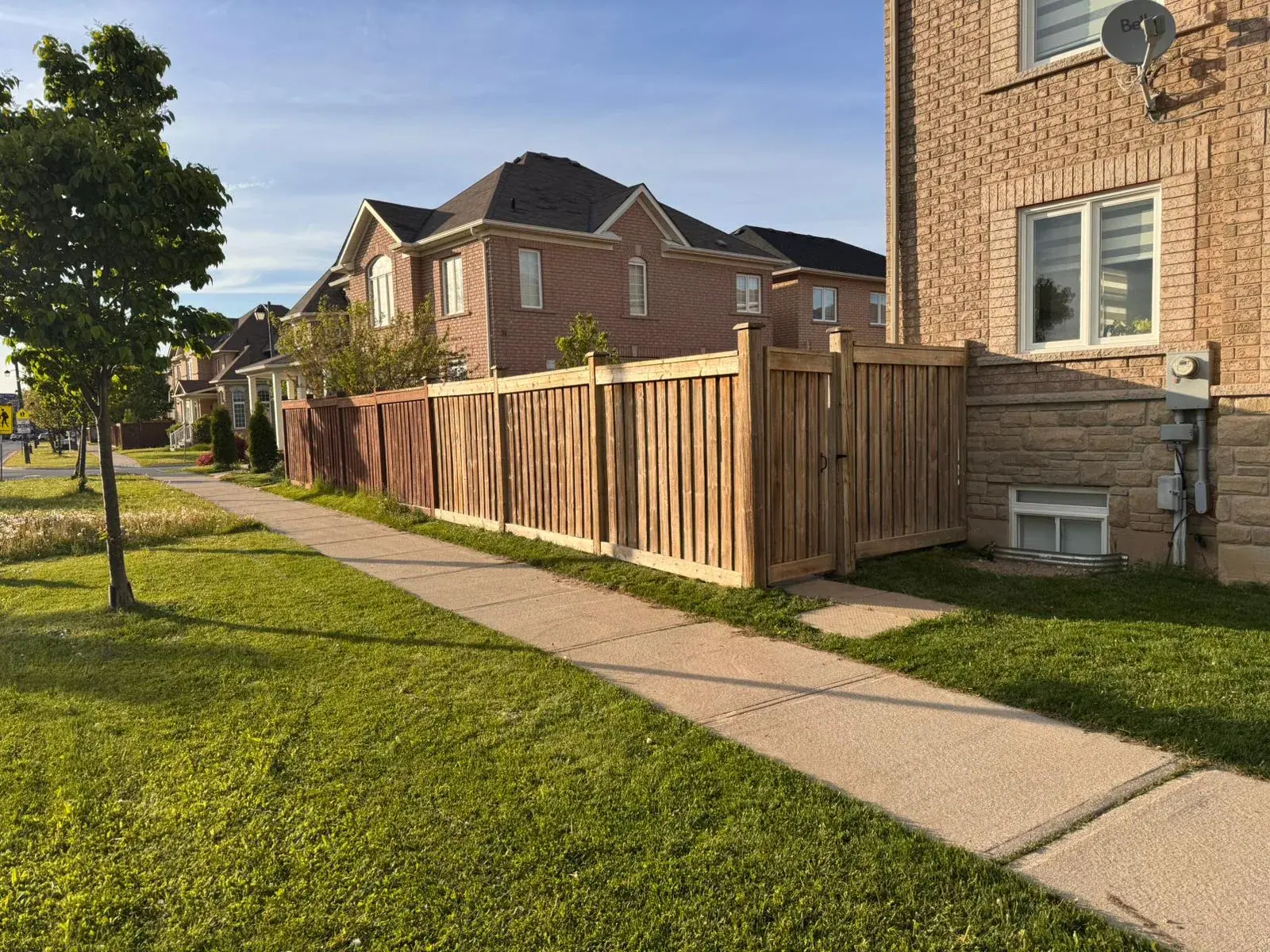
Frequently asked questions
Can fence posts be replaced in winter?
It is much harder. Frozen ground is slow to dig, concrete shouldn’t be poured against frozen soil, and every new hole needs a utility locate first. Brace or tie off a leaning section for now, and replace the post once the frost is out.
Why does my gate stick in winter but swing fine in summer?
The gate post moves with the ground. As the soil freezes it can lift or tilt the post enough to throw the latch out of line, and it settles back as the ground thaws. A post that moves every winter needs to be reset deeper, with water draining away from it.
Is it safe to leave a leaning fence until spring?
Usually, if it is braced and nothing depends on it. A section leaning toward a neighbour’s yard, a sidewalk or a lane should be braced now, because winter winds can push it over. A pool fence, or one that keeps children or a dog in, should be fixed before it is relied on.
Can I burn old fence boards in my fireplace?
Not if they are pressure-treated. Wood Preservation Canada says treated wood should not be burned, and that residential treated wood goes out with regular trash collection or to a landfill.
Further information
Read next
Project planning
Garden suite or home addition: which kind of extra space do you need?
Compare connected living space with a separate dwelling before choosing a direction for your property.
Read the guide →Project planning
What to prepare before asking for a deck-building estimate
Plan the use, dimensions, material preferences and existing-condition questions that make a deck consultation productive.
Read the guide →Project planning
Use the winter to get a garden suite ready for spring
Most of what decides whether a garden suite can be built happens at a desk, not in the yard. Here’s what to get done between now and the spring thaw.
Read the guide →Let’s talk about your project.
Tell us about your plans, property and preferred timing.